J Orthop Surg Res. 2020; 15: 440. doi: 10.1186/s13018-020-01955-5
Eduard Bezuglov, Oleg Talibov, Mikhail Butovskiy, Anastasiya Lyubushkina, Vladimir Khaitin, Artemii Lazarev, Evgeny Achkasov, Zbigniew Waśkiewicz, Thomas Rosemann, Pantelis T. Nikolaidis, Beat Knechtle and Nicola Maffulli
Thirty-one to 41 % of all injuries in soccer involve the muscles, with most occurring in the thigh. The hamstring muscles account for up to 37 % of all muscle injuries in soccer players, a number on the increase. The second and third most prevalent injuries are the injuries of the adductor muscles of the hip and the quadriceps femoris muscle (23 % and 19 %, respectively). Muscle injuries in elite male football constitute to about a third of total time loss. Hamstring injuries are on the rise and now account for nearly one in every four injuries.
Age, previous history of injuries, imbalance between strength and flexibility, and decrease in both eccentric power and mobility all play an important role in non-contact muscle injury. Eccentric exercises aimed at hamstrings are currently considered the best method to prevent their injury. Most often, muscle injuries occur during eccentric contraction, and eccentric exercises should be included in training programs to prevent muscle injury. Some studies highlighted the association between lumbar and pelvic mobility and the frequency of hamstring injury.
Prayer (also called Salat and Namaz) is a traditional Muslim prayer. In traditional Islam, Salah is performed five times a day. Each Salah consists of a set of repeated movements called Rakats. Up to 48 Rakats may be performed daily, and at least 17 of them are mandatory. Rakat consists of a specific sequence of 7 to 9 postures. Therefore, the overall number of postures taken when performing Salah cannot be less than 119 per day. Each of the nine postures has a specific duration, which varies from 3 – 4 to 40 – 60 s.
The regular practice of Salah may positively impact an individual’s health, including the health of the musculoskeletal, cardiovascular, and nervous systems.
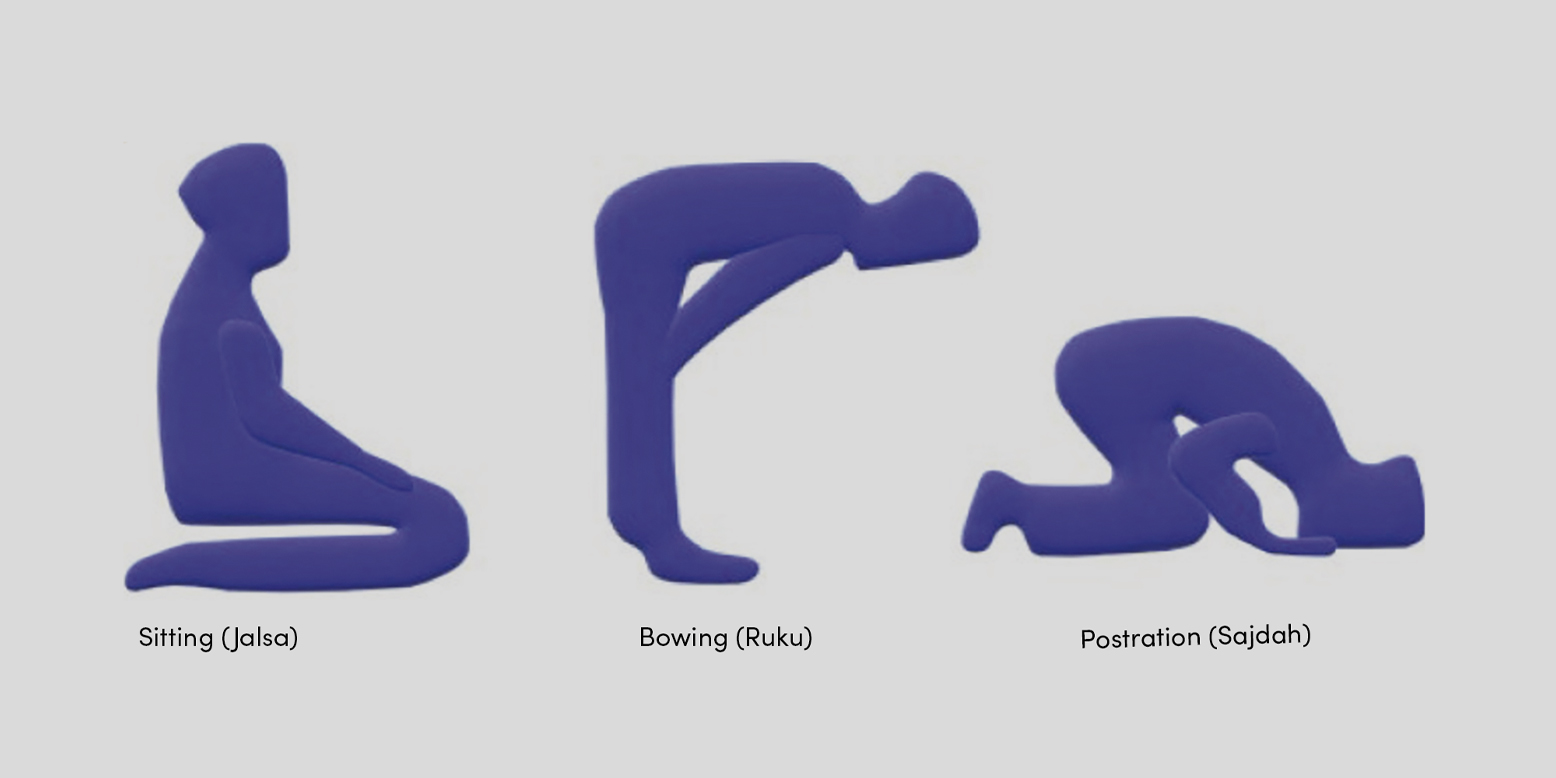
Sitting (Jalsa), Bowing (Ruku), and prostration (Sajdah) postures involve all the muscles of the lower limb and the lumbosacral spine, as well as all the large joints. Most of the movements in these postures involve eccentric loading of certain muscles of the lower limbs. The total time spent in these postures during the day is at least about 20 min.
Bowing posture strengthens the back and increases hip mobility and the mobility of the popliteus tendon. It reduces spinal, back, and neck stiffness and helps to improve body posture, balance, and coordination. Performing movements similar to Bowing positively affects the lower spine and body stability.
Sitting posture leads to the extension of the muscles of the shins and buttocks and to the maximum flexion of the knee joint. This and similar postures reinforce the core and muscles and the muscles of the lower back, an important factor in preventing the development of pain in this region. The regular performance of Salah by soccer players may affect their rate of muscle injuries.
The prevalence of non-contact muscle injuries, including hamstring injuries, were lower in soccer players who regularly perform prayer (Salah). Although the reasons for such finding is likely to be multifactorial, this could be attributed to eccentric lengthening of the muscles of the lower limbs during certain movements undertaken several times per day during prayers plays a major role.
Literatur
- Eduard Bezuglov, Oleg Talibov, et al. The prevalence of non contact muscle injuries of the lower limb in professional soccer players who perform Salah regularly: a retrospective cohort study. J Orthop Surg Res. 2020; 15: 440.
- López-Valenciano A, Ruiz-Pérez I, Garcia-Gómez A, Vera-Garcia FJ, De Ste Croix M, Myer GD, Ayala F. Epidemiology of injuries in professional football: a systematic review and meta-analysis. Br J Sports Med. 2019. 10.1136/bjsports-2018-099577.
- Hägglund M, Waldén M, Magnusson H, et al. Injuries affect team performance negatively in professional football: an 11-year follow-up of the UEFA champions League injury study. Br J Sports Med 2013;47:738–42.
- Hickey J, Shield AJ, Williams MD, et al. The financial cost of hamstring strain injuries in the Australian football League. Br J Sports Med 2014;48:729–30.
Autoren

is Specialist Physical medicine and rehabilitation (MBBS, M.SC.) , Dubai Physiotherapy and Rehabilitation center (DPRC), Dubai health Authority. He ist Assistant lecturer Ain Shams University, Cairo, Egypt and also Member in the Egyptian Society of Physical medicine and Rehabilitation, in Emirates society of rehabilitation and sports medicine and in International Society of Physical medicine and Rehabilitation (ISPRM).